
 Order Management
Peak season is not December, it is November
Our data from 2022 to 2025 show that November brings 54% more orders than September on average. In August we processed more than three million orders in a single month for the first time, and the seasonal peak is still ahead of us.
TL;DR (In short)
- From 2022 to 2025, growth from September to November was between 44.5% and 64% every year.
- November has pushed December aside. For the last three years it has been the strongest month of the year without exception.
- September is not a weak month, it is the calm before the storm. Anyone testing their capacity then is testing it in the easiest period of the year.
- Nothing breaks, the volume simply grows. Every inefficiency that goes unnoticed in September is multiplied by 1.5 in November.
- Whatever you want to improve, sort it out in September or October. You do not touch a working operation in November.
Every year in mid-November we get the same call
Orders doubled in ten days, the warehouse cannot keep up, support is three days behind, and it all needs fixing by next week. On the other end of the line is rarely someone who has been careless. It is usually a successful merchant who runs a good store and has worked deliberately all year, and who is now packing parcels alone until midnight for the third evening in a row.
Almost every time, the same sentence comes up: everything was still fine in September.
It was. And that is exactly the trap. In November there is little room left to change the operation, because every change risks stopping shipments. Whatever you want to improve or automate in order processing has to be in place in September or October, not in the middle of the biggest wave.
What six years of our data show
We have tracked the volume of orders processed in Order Management since 2020, and we publish the aggregate on this blog every month. The curve is the same every year: September is quiet, October starts to climb, and November jumps sharply.
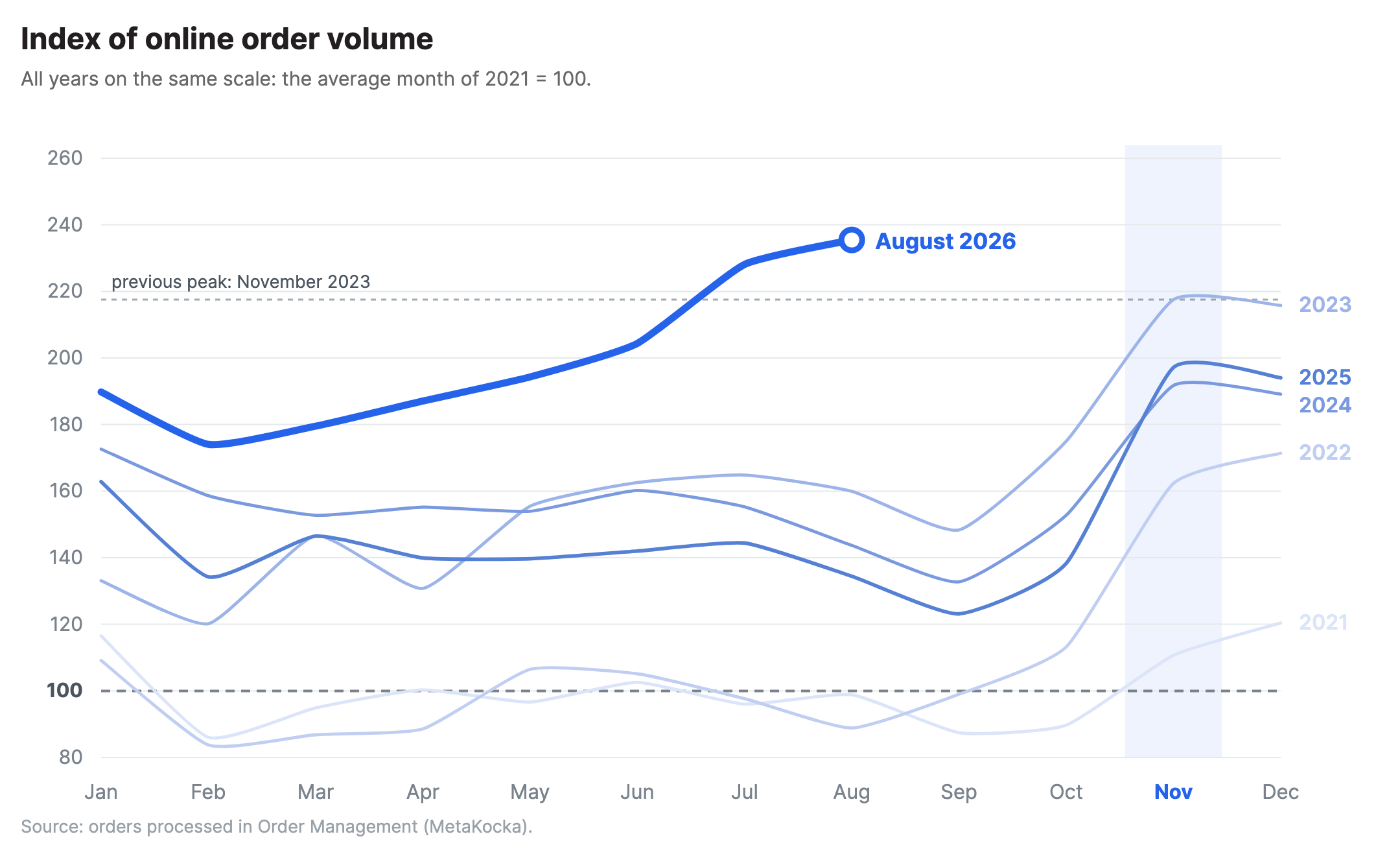
The chart does not show absolute figures but an index. All years are measured on the same scale, where the average month of 2021 is worth 100, so both the growth in volume and the exact moment of the peak are visible at once. The November band is highlighted.
Three things stand out in this data:
- November has definitively pushed December aside. In 2023, 2024 and 2025, November was the strongest month of the year without exception, whereas December used to hold that position. The reason is well known: Black Friday has grown from a one-day discount into multi-week campaigns that start in mid-November.
- September is a deceptive lull. It counts as one of the lowest points of the year, but not because demand is weak. It is the calm before the storm.
- The last quarter produces almost a third of the year. Over the last three years, October, November and December together brought between 28% and 31% of all annual orders. A quarter of the calendar therefore demands almost a third of the entire operation.
To give a sense of what that means in practice: in November 2025 we processed an average of 32,000 more orders per day than in September of the same year. Every day, for a whole month.
In August we passed three million orders for the first time
In August 2026, Order Management processed 3,066,319 orders. That is the first month above three million and the highest month across all six years of tracking. The previous record was held by July 2026 with 2,970,690 orders, and before that by November 2023.
That both records happened in July and August, the months of the summer lull, is the most telling part of this story. Against August last year the volume was 75.2% higher, and the first eight months of this year are 39.2% above the same period last year.
This needs to be said honestly: this is growth of our platform, not growth of the market. Part of it is new customers. The seasonal pattern, however, is robust, because it repeats six years in a row regardless of how many merchants are on the platform.
Together this means one thing: the seasonal jump will not be added to last year’s figures but to this year’s higher base. If the ratio between November and the rest of the year stays within the range of the last five years, November will bring us between 2.9 and 4.4 million orders. The range is deliberately wide, because this is a calculation from historical patterns and not a forecast. What is clear is that November will exceed this year’s summer records.
Why September is the most deceptive month of the year
Take a store that processes 500 orders a day in September. This is an example for the arithmetic, not our data. Processes run without trouble: two people in the warehouse pack every parcel without stress, support replies within half an hour, the carrier collects the goods at five, and by half past five the lights are off. Nothing suggests anything needs changing.
At the average seasonal growth of 54%, that same store processes 770 orders a day in November, which is 270 more parcels every day.
The people stay the same, the space is the same, there is still one label printer, the procedure is unchanged. Nothing broke, the volume simply grew. And every small inefficiency that went unnoticed in September is multiplied by 1.5 in November.
Five places where the pressure shows first
All five belong to the same area, order processing, which is also where the data in this article comes from. The figures in the points are arithmetic from the example above with 500 orders a day, not industry statistics.
1. Retyping data between systems
If you retype, copy or import orders from your online store into an accounting or warehouse system through Excel files, that is a cost that grows in direct proportion to volume. In November the work falls behind not because people are less efficient, but because there is simply too much of it.
At 500 orders a day, every minute of manual work per order means 4.5 hours of extra work per day.
in November. This is removed by a direct connection between the online store and the order processing system. The order arrives automatically, and with it come the warehouse task, the invoice and the updated stock, without a single manual entry.
2. Choosing the carrier and printing labels
Most merchants work with several delivery services, because prices and speed differ by weight, destination and type of shipment. In September choosing manually is still manageable, but in November it becomes a bottleneck, when the same decision has to be made 770 times a day.
If you take more than five steps per shipment, you have a lot of room for improvement. Four unnecessary clicks per shipment mean 3,080 unnecessary clicks a day.
in November. If you know that all parcels up to two kilograms go with one service, heavier ones with another and international ones with a third, that is no longer a decision but a rule. People make decisions, systems can execute rules: it picks the delivery service itself based on weight, dimensions and destination country, and prints the labels for all parcels at once.
3. The “where is my parcel?” questions
This is the most underestimated hidden cost of the season. When volume grows by half, the number of customers checking their delivery status grows proportionally. In November and December buyers are even more sensitive, because purchases are tied to gifts with a deadline.
If such a question comes up for every ten shipments, in November that means 77 conversations a day. That is no longer a quick task but the full working time of one person who spends the day checking tracking numbers.
The vast majority of these questions are removed by proactive notifications: the message goes out on its own when the parcel ships, when the courier collects it and if it is delayed. On top of that the customer has a tracking page in your store’s own look, so the question mostly never arises.
4. Incomplete and wrong addresses
A failed first delivery is a double blow: you pay for transport twice, the parcel returns to the warehouse where someone has to process it again, and the customer is unhappy. During the holidays every lost day is critical.
At an error rate of 5%, in November that means 38 returned parcels a day that require manual handling.
A large share of these errors is caught at order import, when the system checks the postcode and the address format and warns before the parcel leaves. The rest is solved by letting the customer correct the address themselves through a link in the confirmation message, while the parcel has not yet been handed to the courier.
5. Returns, which come due in January
The season does not end on 31 December but when all the returns have been processed too, and those peak in early January. By then the team is already worn out and the December adrenaline is gone.
If handling returned parcels is manual, January becomes a second November, only without the new revenue.
. The January wave does not pile up if the customer reports the return through a web form, and the warehouse, when scanning the returned item, automatically updates stock and prepares the credit note.
Worth checking
Before you go looking for a new tool, open your own account and see what is already switched on. Among the merchants we talk to, at least one of the five points above can often be solved with a setting that is already available, only nobody has needed it yet.
What you can sort out in September
None of the above is sensible to solve in the middle of the November fever. September is the time for changes, because you still have room to test and a mistake will not cost you the season.
- Measure your starting point.. Orders per day, minutes of manual work per order, steps per shipment, the share of delivery questions, the share of failed first deliveries.
- Look at your processes through a factor of 1.5. Multiply every figure from the first point by 1.5 and ask yourself where it stalls first.
- Remove the manual retyping. Every file export and import is a candidate for a connection between systems.
- Turn decisions into rules. Choosing the delivery service, the warehouse and the document should happen by itself.
- Switch on proactive notifications. The cheapest measure on this list, because it removes questions before they arise.
- Test in October. A new process has to run for a full month in calm conditions before it goes into the season.
November is too late for optimisation. All it does then is show who took a few hours in September to look through their own numbers. Those few hours are often the difference between a season you remember for record profit and a season you remember for burnt-out staff and missed shipments.
The good news is that today you are still on the right side of the calendar.
Make this November bring you a record instead of chaos
Try MetaKocka and put order processing, delivery and customer notifications into one system, while it is still September.
| Try it out |
The data in this article is based on aggregated and anonymised orders processed in Order Management between 2020 and 2026. The stores are based in Slovenia, Croatia and the wider region, while a large share of parcels goes to buyers elsewhere in Europe. This is the sample of one platform and not industry research.
MetaKocka will be present as an exhibitor and expert partner at the eCommerce Hrvatska conference on 13 October 2026 in Zagreb. If you are there, come and say hello.
Wishing you business success,
MetaKocka Team
Would you like to be informed about news and optimizations?